
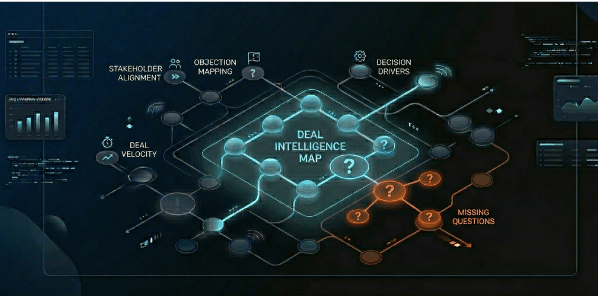
The Missing Layer
The layer that's been missing all along.
Every sales organization teaches its reps how to qualify a deal. That's necessary — but qualification is focused on the seller. It tells the rep whether the deal is worth pursuing. It tells them nothing about what the customer needs to understand in order to take action.
That is the missing layer. A systematic way to focus on the customer's decision — not the seller's process. What does this specific customer need to understand? What questions are they still wrestling with? What concerns haven't they voiced yet? What would it take for them to say yes?
Without that layer, reps default to what they know — pitching the product, running the sales process, checking the qualification boxes. And the customer, left without the guidance they need to make a confident decision, does nothing. That is where 40 to 60 percent of forecasted deals quietly disappear. Not lost to a competitor. Just gone.
SpotLogic is that missing layer. It points the rep's attention at the customer's decision — defining what needs to be understood, organizing what has been learned, and making visible what still needs to be addressed. That is what gives a new rep the ability to do what your best reps do instinctively: help the customer understand what they need to take action.
Three Core Concepts
Everything else
follows from these.
Concept 01
The Information Model
Concept 02
The Information Position
SpotLogic provides every new rep with a structured set of questions organized by the topics that matter most to how this specific type of customer makes this specific type of decision. It covers the full arc of the deal, from the first conversation through close. It is not a script or a sales methodology. It is a decision map: a precise definition of what the rep needs to learn in order to help the customer take action.
The Information Model is created by SpotLogic leveraging its deep experience with complex solution sales. Each model is optimized for the specific combination of business problem, product, and customer industry that defines this decision. The rep starts every deal with a decision map for this specific type of customer, not a blank page.
As reps work deals, they adapt the decision map to reflect what they discover about each specific customer. Those refinements are captured and, with input from authorized contributors like sales managers and enablement teams, become the basis for an increasingly refined model that is yours alone. SpotLogic builds this as a proprietary asset for your organization.
The decision map becomes the starting point for every future decision of the same type. The more deals your team runs through SpotLogic, the more indicative that decision map becomes of how your specific customer base actually decides.
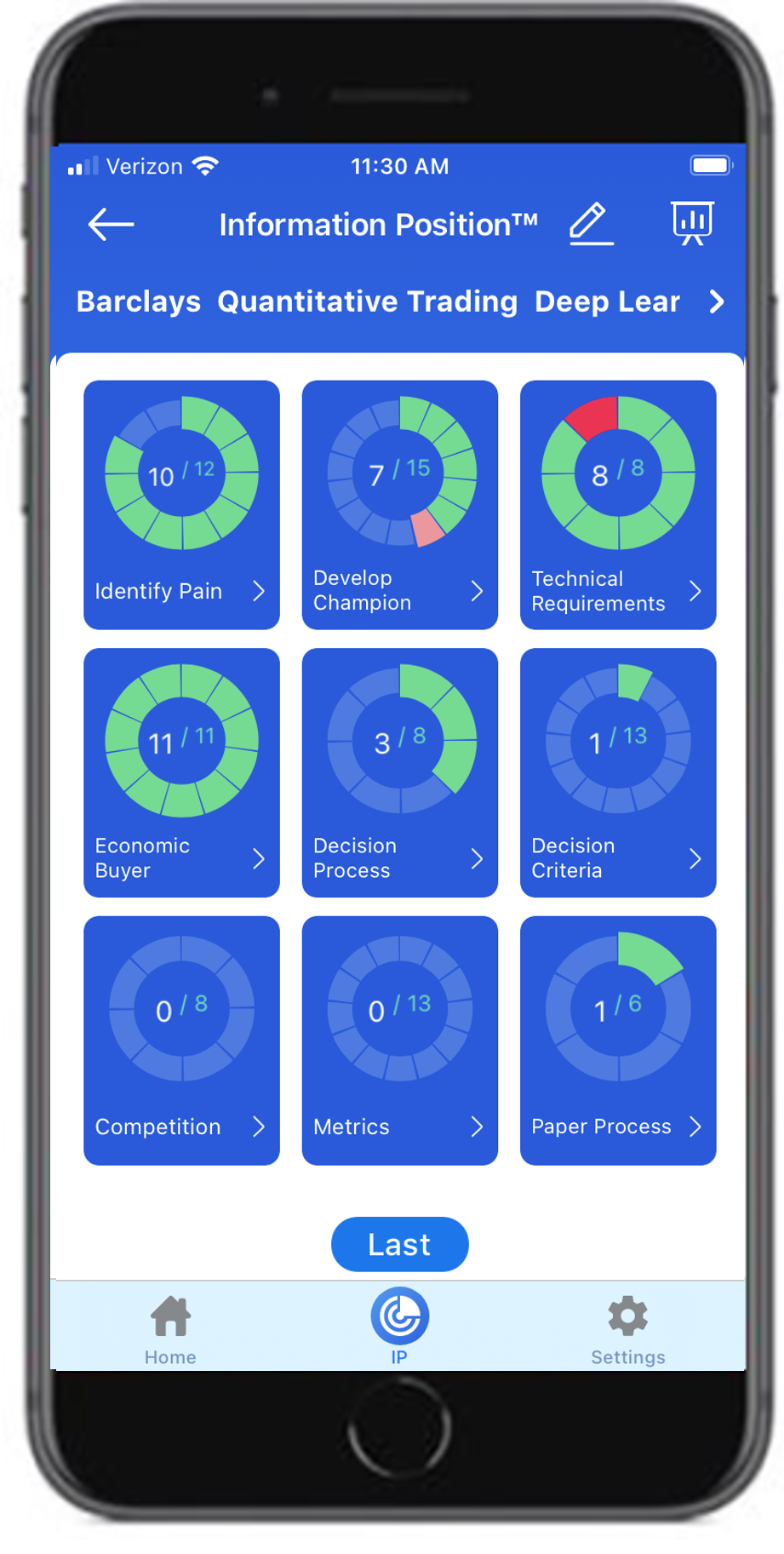
As the rep works the deal, the Information Model fills in with what the customer actually said. When an answer is captured it is automatically recorded as known and shown in green. The rep or manager can then change the color indicator to pink to flag that it needs more follow-up, or to red to indicate a risk that must be addressed before the deal can move forward. What hasn't been addressed yet remains empty.
At any moment, the rep and the manager can see the complete state of the customer's decision, visually and instantly, without the significant time investment required for a human to piece that picture together manually from notes, transcripts, and memory.
Concept 03
The Manager’s Deal Lens
The Deal Lens is the manager's view of the Information Position across every new rep and each of their deals. Filtered to show only the variables the manager cares about most. Updated in real time. It replaces the pre-coaching interrogation call with immediate clarity so that every coaching conversation starts at the point of actual need.
A new rep.
A first real deal.
SpotLogic in action.
The Setup
Your new rep is three weeks into the role. The first real lead is on the table. Training is done — and your rep understands how important it is to uncover the customer's problem in depth. But knowing that and knowing how to do it are two very different things. Your rep has never sold this product to this type of customer before. This is exactly the moment SpotLogic was built for.
Before The Call
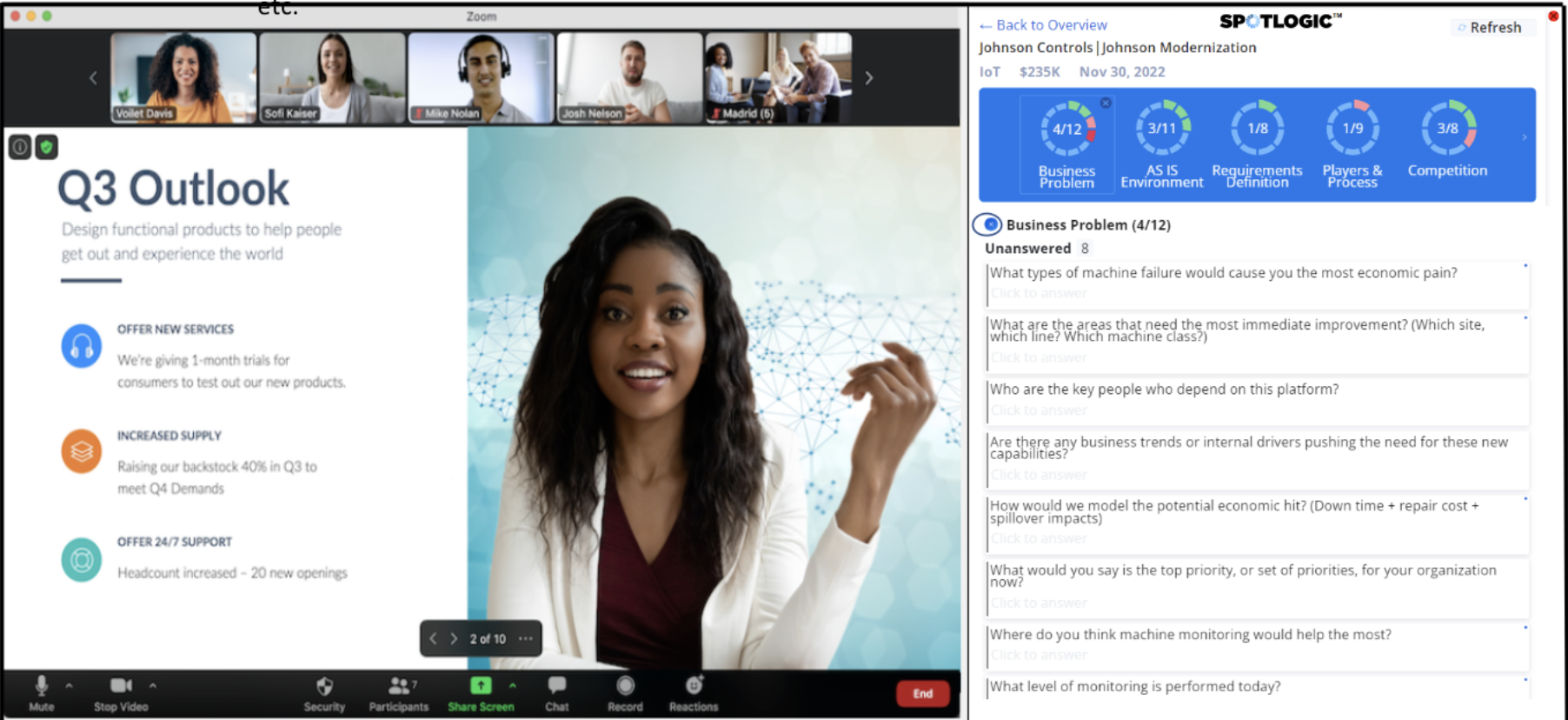
The first customer call is a Zoom. The customer mentions at the outset that they don't allow meeting transcriptions. That's fine — SpotLogic doesn't require them. Your rep opens SpotLogic on the desktop alongside the video call. Based on the current state of the Information Position, SpotLogic has already suggested the most valuable topics and questions to focus on in this meeting — starting with the business problem, where the gaps are most urgent. Your rep reviews the recommendation, makes any adjustments they see fit, and enters the conversation with a clear path into the customer's world. No guesswork. No blanks. Just the right questions at the right moment.
During The Call
Your rep leads with the high-impact questions SpotLogic suggested for this meeting. The customer is engaged and shares more than expected. The conversation doesn't follow a linear path. It rarely does. The customer raises their solution vision before the business problem is fully understood, then circles back to operational requirements unprompted. Your rep moves fluidly between topics in SpotLogic with a single click, following the conversation wherever it leads, leading when the opportunity presents itself, adding depth when the customer expands the scope. The structure is always there. The rep is always present.
After The Call
After the call, the rep snaps an image of their handwritten notes. SpotLogic reads the image and automatically extracts the answers to every relevant question in the Information Position — including information the customer offered proactively, even if the rep never asked the question directly — mapping each one to its precise location in the model.
If the customer raised a topic that isn't in the current model, SpotLogic flags it and recommends the rep consider adding it, along with suggested questions. The model becomes more tailored to this specific customer's decision with every interaction.
Should the rep want to input additional information, they can do so at any time by selecting a specific question and speaking or typing the answer directly to it.
The Information Position
SpotLogic updates the Information Position instantaneously, right on the same screen. The Information Position is the app. What was a mostly empty model at the start of the call is now partially filled in.
Some segments are green: the customer was clear and the answer is complete. Others are pink: something was captured but needs more detail. A few are red: the customer said something that signals a risk that needs to be addressed before this deal can move forward. Everything that is not green is a gap. And your rep can see every one of them at a glance.
Between Conversations
Later that evening, your rep glances at the SpotLogic mobile app. Two pink segments in the operational requirements topic are still there, impossible to ignore. SpotLogic may suggest a specific follow-up question based on what's still missing. Or the rep may already know exactly what to ask. Either way, a quick email to the customer. Two minutes. Done.
That is how the Information Position increases deal activity organically. The structure makes what still needs to be done impossible to ignore, and gives the rep a clear path to addressing it.
The Manager’s View
You already know
where every deal
stands.
Opening The Deal Lens
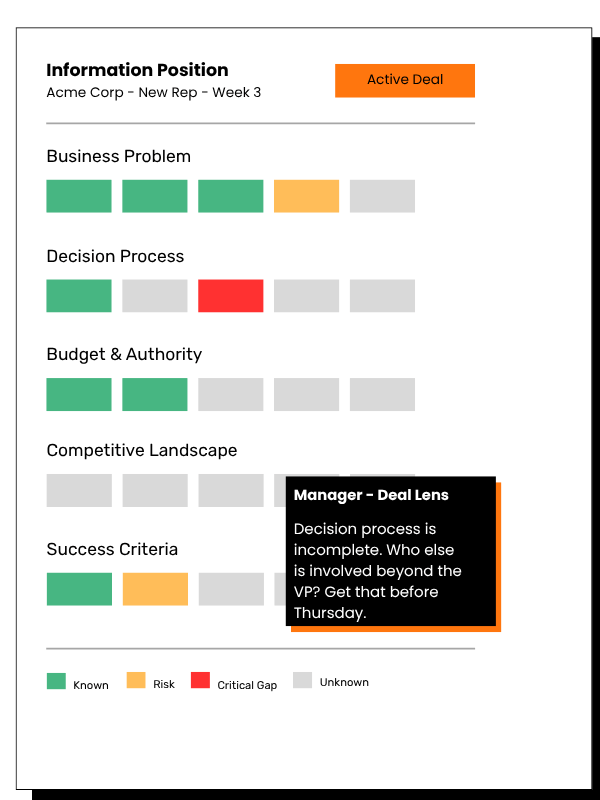
You open Deal Lens. Rather than calling your rep to ask where things stand, you can see the Information Position of every active deal in real time — filtered to show only the variables you've chosen to track. Those variables are marked with a blue dot in your rep's view, so your rep always knows exactly what you've selected as the information elements you want to actively manage.
Coaching At Scale
You open Deal Lens at ten o'clock at night — the first moment you've had to look at your new rep's deals today. What you see is immediate and unambiguous. Business problem largely green. Operational requirements showing red. Stakeholder priorities untouched. You already know exactly what needs to happen next.
You choose not to call. Not because you don't have something valuable to say — but because for the first time you have the precise, decision-level information to say it without a conversation. You send a coaching message through Deal Lens, tagged to the specific opportunity. The rep sees it on their home screen in the morning and reads it with a single tap — the full context of the deal right there, your guidance attached to it.
This is coaching at scale. Not because the messaging technology is unique. Because the information behind it finally is.
Your next new rep doesn’t have to start from zero.
Request a demo and we'll show you a live Information Position built for your product and your customer type so that you can see exactly what your new reps would be working with from day one.